Signal 03 / Location and events
Locate the meaningful event
A position tells you where a device was estimated to be. A milestone tells you what a system recorded. To understand a container move, keep those claims separate.
Read the event checks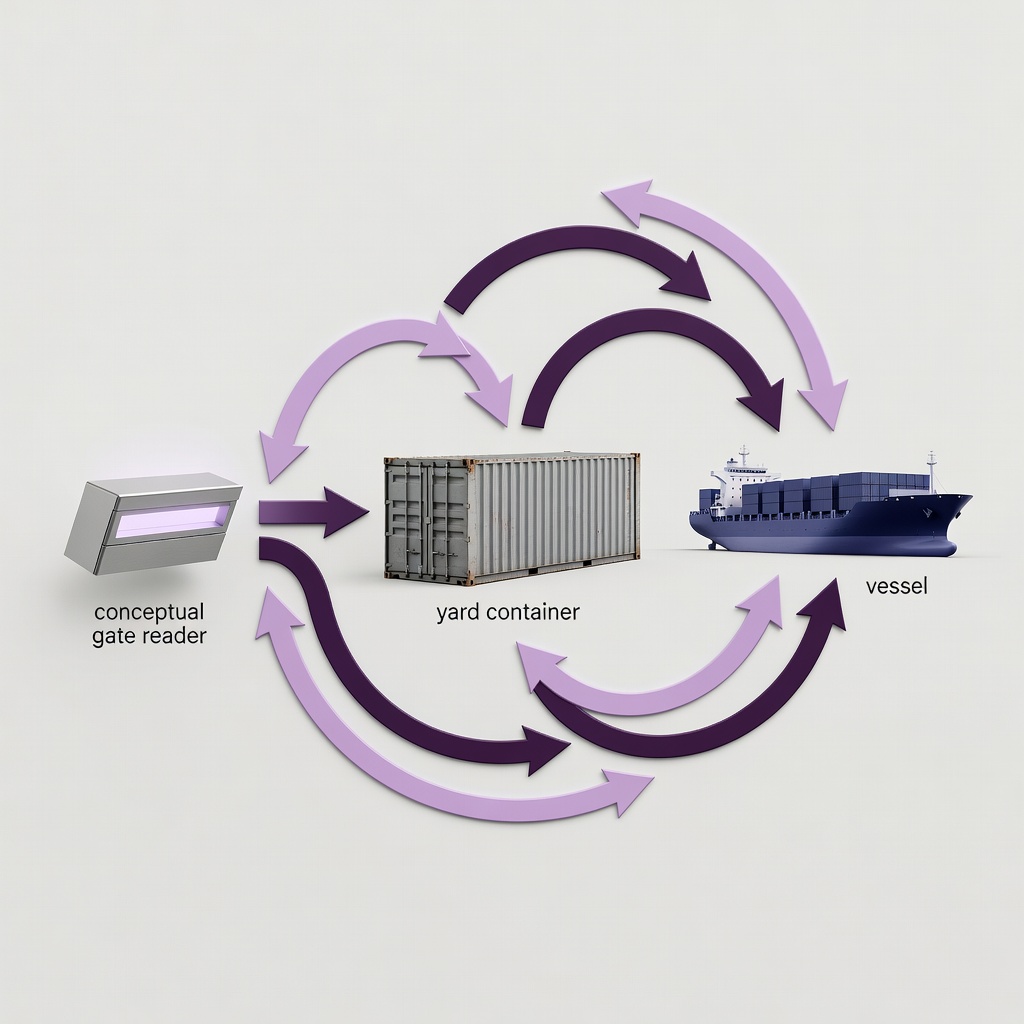
Distinguish a point from an action
A location observation and an operational event are different kinds of evidence. A device may report coordinates near a terminal. Separately, the terminal may record a gate-in transaction for a specific container. Those records can support each other, but they are not identical. A point near the entrance does not establish that the equipment passed every gate check.
Global Navigation Satellite System, or GNSS, is the broad term for satellite positioning systems that include GPS and Galileo. A receiver estimates its position from available signals. Reception, obstruction and the device’s installation affect performance. The resulting coordinates describe the receiver, so the association between that receiver and the container remains an essential part of the evidence.
Read terminal milestones literally
Gate in, discharge, load and gate out describe different actions. A discharge event generally concerns removal from a vessel; a gate-out event concerns departure through a terminal boundary. Neither should be substituted for the other. A container can be physically within a terminal while still waiting for clearance, handling or transport arrangements.
Event definitions vary across systems and processes, so confirm the vocabulary used by the source. DCSA Track & Trace standards offer shared structures for shipping visibility, while GS1 EPCIS supports structured visibility-event information across supply chains. Standards help systems communicate, but local implementation still matters. Ask whether an event is an actual observation, a planned step or an estimate, and retain that distinction when sharing it.
Give every timestamp a job
The event time is when the reported action occurred. The publication or receipt time is when another system made that information available or received it. An event recorded overnight might reach your screen later. Sorting only by receipt time can make a sensible physical sequence appear contradictory, especially when different organisations publish at different speeds.
Time zones and daylight-saving changes can create further confusion. Keep a clear offset or a documented UTC representation, and show local time carefully when people coordinate appointments. If a source corrects an event, preserve the relationship between the correction and the original record. A timestamp without an identified meaning is not enough to judge freshness or the order of a container’s moves.
Use geofences with appropriate caution
A geofence is a defined geographic boundary used to trigger a rule when a location appears to enter, leave or remain within an area. It can help flag arrival near a depot or terminal. However, the boundary is a modelling choice. Nearby roads, waiting areas and adjacent facilities can make a simple enter-or-exit interpretation misleading.
Location uncertainty and irregular reporting can produce apparent jumps across a boundary. Some systems require repeated observations or a dwell period before generating an event. Those rules reduce certain errors but introduce their own delay. A geofence alert should therefore be labelled as such, rather than being presented as the terminal’s confirmed gate transaction or as authorisation for a driver to proceed.
Do not move the container with the vessel
Vessel tracking often uses Automatic Identification System, or AIS, information. A vessel position can support a transport estimate when a container is confirmed aboard that vessel. It does not independently identify the container or prove that loading occurred. A planned sailing association may be outdated if equipment was rolled to a different departure or discharged earlier than expected.
The same caution applies to trucks and trains. A tractor’s position is not automatically the position of a trailer or container after a handoff. Device assignments, transport associations and load confirmations need to follow the physical movement. Whenever a display derives the container’s position from another asset, that inference should remain visible to the reader rather than masquerading as a direct container observation.
Resolve gaps before promising the next step
When records disagree, start by comparing identity, source, event definition and timestamps. A missing gate-out update may reflect delayed publishing rather than continued presence. Conversely, an estimated arrival should not overrule a confirmed event without investigation. Keep uncertainty explicit and ask the responsible operator for clarification when a decision depends on it.
Ports such as Rotterdam, Antwerp-Bruges and Hamburg contain multiple terminals and operational areas. A port-level location is usually less specific than a terminal or yard reference. For a collection plan, confirm the relevant facility, release conditions and appointment process instead of relying on the port name alone. The next guide explains how these observations feed the systems that coordinate an actual handoff.
Next: connect the port handoffs →An event sequence you can question
Explanatory sequence only. It is not a shipment record and does not imply that every terminal uses these exact milestones.
- Arrival estimateA forecast, with a named source.
- Discharge recordedAn action reported by an operational source.
- Readiness checkedSeparate release and collection conditions reviewed.
- Gate out recordedA terminal departure event, not proof of final delivery.
Reference points
Explore DCSA, GS1 EPCIS and the Port of Rotterdam for standards and port context. A standard event model is not a guarantee of an individual data feed’s accuracy.